Corneal Dystrophies: What They Are and How They Affect Your Vision
Read time: 4 minutes
The cornea is the clear, curved front surface of your eye. It helps focus light so you can see clearly. For the cornea to work well, it needs to stay smooth, healthy, and transparent. When something disrupts that structure, vision can become blurry or uncomfortable.
One group of conditions that can affect the cornea is called corneal dystrophies. These conditions are usually inherited, meaning they run in families. They often develop slowly and affect both eyes. Some people never notice symptoms, while others may have irritation, vision changes, or recurring problems.
Understanding what corneal dystrophies are can help you recognize early signs and know when to seek care.
What Are Corneal Dystrophies?
Corneal dystrophies are genetic disorders in which material builds up in one or more layers of the cornea. They are not caused by injury, infection, or lifestyle. Most types progress over time.
Common features include:
- They usually affect both eyes
- They can appear at different ages, depending on the type
- They often run in families
- They may cause vision changes, irritation, or no symptoms at all
Even though they vary in severity, early diagnosis helps protect long-term comfort and clarity.
The National Eye Institute provides additional information about corneal dystrophies and how they develop.
The Cornea’s Layers: Why They Matter
Each layer of the cornea has a different job. Dystrophies are named based on which layer they affect.
The main layers include:
- Epithelium: The surface layer that protects the eye
- Bowman’s Layer: A strong layer under the epithelium
- Stroma: The thick middle section that keeps the cornea clear and shaped
- Descemet’s Membrane: A thin supporting layer
- Endothelium: The inner layer that pumps fluid out to keep the cornea clear
Problems in different layers create different symptoms.
If you're curious about the eye’s internal structure and how each part contributes to clear vision, you can learn more in our article The Amazing Eyeball, Part 2.
Common Types of Corneal Dystrophies
There are many corneal dystrophies, but these are some of the most common:
1. Epithelial Basement Membrane Dystrophy (EBMD)
Sometimes called “map-dot-fingerprint” dystrophy.
- Causes the surface cells to stick poorly
- Can lead to recurrent erosions (painful episodes when the surface loosens)
- May cause blurry or ghosted vision, especially in the morning
2. Fuchs’ Endothelial Dystrophy
Affects the innermost corneal layer.
- The endothelial cells slowly stop working well
- Fluid builds up, causing morning blur, glare, and cloudiness
- More common in adults over 50
- Advanced cases may require corneal surgery such as DMEK or DSEK
Learn more about Fuchs’ dystrophy from the American Academy of Ophthalmology.
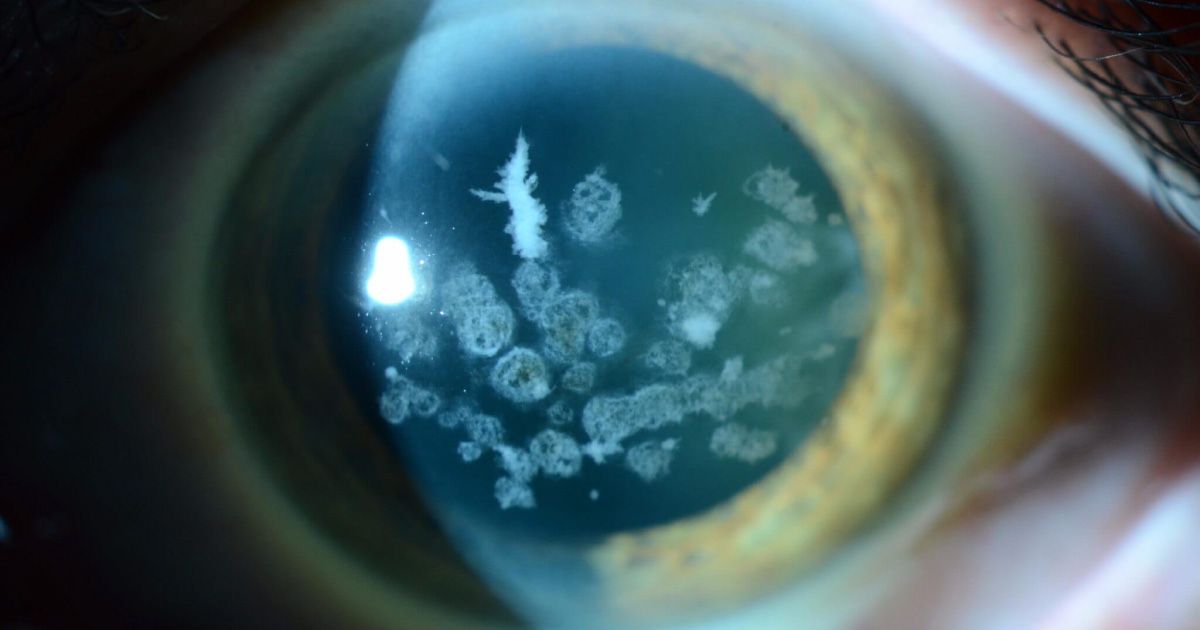
3. Lattice Corneal Dystrophy
- Deposits form in the stroma in a branching “lattice” pattern
- May cause recurrent erosions
- Can gradually reduce vision as deposits increase
4. Granular Corneal Dystrophy
- Creates small, white, crumb-like spots in the stroma
- Vision may stay clear for many years before symptoms develop
- Type II (Avellino) combines granular and lattice changes
5. Macular Corneal Dystrophy
- Rare and often more severe
- Causes cloudy areas throughout the stroma
- Usually appears earlier in life and can significantly affect vision over time
Common Symptoms of Corneal Dystrophy
Some people never notice symptoms, but others may experience:
- Blurry or fluctuating vision
- Glare or halos, especially at night
- Light sensitivity
- A gritty or foreign body sensation
- Morning blur
- Sharp pain during recurrent erosions
If symptoms come and go or seem to worsen slowly, it’s worth having a full corneal evaluation.
How Corneal Dystrophies Are Diagnosed
Eye doctors use several tools to diagnose corneal dystrophies, including:
- Comprehensive eye exam
- Corneal topography to map surface shape
- OCT imaging to see layers of the cornea
- Specular microscopy to measure endothelial cells
- Fluorescein dye to check for erosions
- Family history review to identify patterns
These tests help determine the type of dystrophy and how much it has progressed.
Treatment and Management
Treatment depends on the type and how much it affects vision.
Non-surgical treatments include:
- Lubricating eye drops for dryness or irritation
- Hypertonic saline drops or ointment for morning cloudiness
- Bandage contact lenses to help with corneal erosions
- Medications to support healing or reduce inflammation
Surgical or procedural treatments include:
* Epithelial debridement for chronic EBMD
* PTK (phototherapeutic keratectomy) to smooth the cornea and reduce erosions
* DMEK (Descemet Membrane Endothelial Keratoplasty) or DSEK (Descemet Stripping Endothelial Keratoplasty) for advanced Fuchs’ dystrophy
* Full corneal transplant for severe stromal dystrophies
Many procedures today are minimally invasive with excellent success rates.
The Takeaway
Corneal dystrophies are a group of genetic conditions that can affect vision and eye comfort in different ways. Some remain mild for years, while others may cause irritation, morning haze, or progressive clouding. Early diagnosis is key, and modern imaging allows eye doctors to detect subtle changes long before symptoms become significant.
If you’re noticing recurring eye discomfort, changes in clarity, or have a family history of corneal conditions, schedule an appointment at Urban Optiks Optometry. Our team can help with advanced testing, expert diagnosis, and personalized care.
Share this blog post on social or with a friend:
The information provided in this article is intended for general knowledge and educational purposes only and should not be construed as medical advice. It is strongly recommended to consult with an eye care professional for personalized recommendations and guidance regarding your individual needs and eye health concerns.
All of Urban Optiks Optometry's blog posts and articles contain information carefully curated from openly sourced materials available in the public domain. We strive to ensure the accuracy and relevance of the information provided. For a comprehensive understanding of our practices and to read our full disclosure statement, please click here.