Born Farsighted? How a Baby’s Eyes Grow Into Focus
Read time: 5 minutes
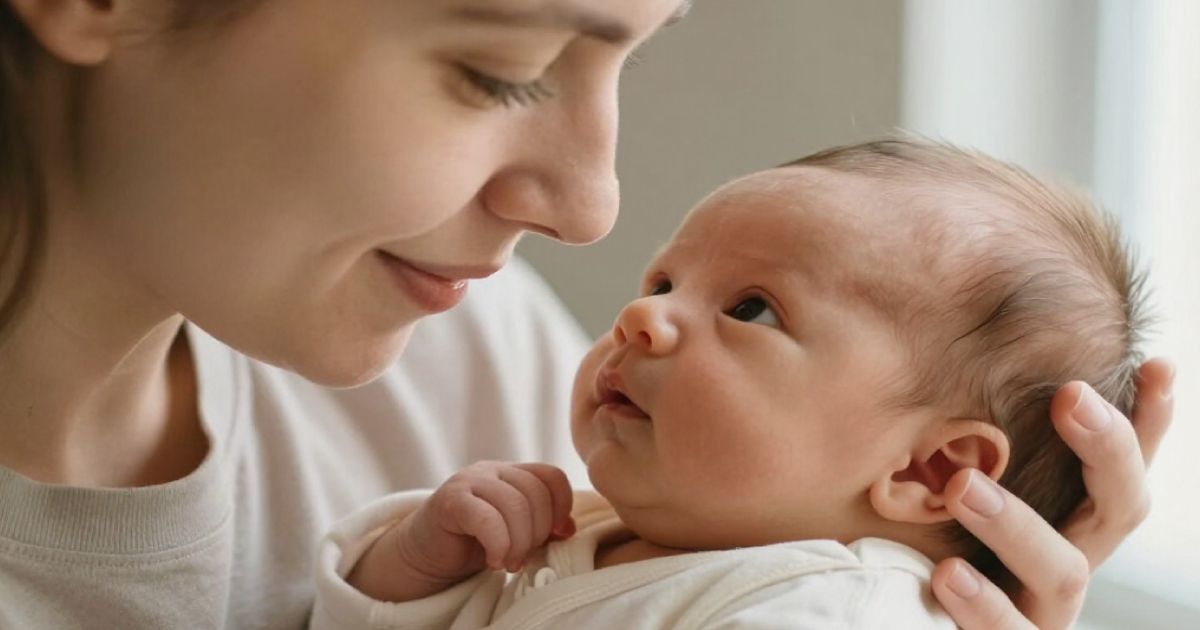
If you've ever held a newborn and wondered whether they can really see you, the answer is yes but not the way an older child or adult can. A baby's visual system is still developing, and mild farsightedness is very common during infancy.
That is not usually a flaw or a warning sign. It is part of the remarkable way the eyes grow and adjust during early childhood.
The Short Version: Small Eyes, Changing Focus
Farsightedness, or hyperopia, happens when light entering the eye would focus behind the retina instead of directly on it when the eye is relaxed. One common reason is that the eyeball is shorter from front to back than it will eventually become.
Babies are born with much smaller eyes than adults, and their eyes continue growing rapidly during infancy and childhood. As the eye grows, its focusing system changes along with it.
For more about farsightedness, The American Academy of Ophthalmology explains how hyperopia affects the way light focuses inside the eye.
Meet Emmetropization
There's a name for the process that helps bring a child's eyes closer to their ideal focus: emmetropization.
During this process, the eyeball grows longer and the optical power of the cornea and lens changes. Together, these changes tend to move the eye toward a lower amount of refractive error.
Think of it as a gradual fine-tuning process rather than a single growth spurt.
Emmetropization is particularly active during infancy and early childhood. Research shows that refractive error tends to move toward lower levels of hyperopia as the eye grows, although the amount and timing vary from child to child.
At the same time, the retina, brain, and visual pathways are developing. Babies become better at detecting detail, following objects, coordinating their eyes, and interpreting what they see.
Why Mild Farsightedness Often Doesn't Cause Obvious Blur
Here's the part that surprises many parents: a mildly farsighted child may still see quite well.
That is because the eye has a focusing ability called accommodation. Accommodation allows the natural lens inside the eye to change focus, helping bring images onto the retina.
Children generally have a strong ability to accommodate, so they can compensate for some farsightedness without realizing they are doing it.
This is one reason a child can have hyperopia without complaining that things look blurry.
However, greater amounts of farsightedness may require more focusing effort. As children get older and spend more time reading or doing close work, significant hyperopia can sometimes be associated with:
- Eye strain
- Headaches
- Difficulty sustaining near work
- Blurry vision
- Eye crossing in some children
When Farsightedness Needs a Closer Look
Pediatric eye-care professionals are not concerned simply because a young child has some hyperopia. They look at how much farsightedness is present, whether both eyes are similar, how clearly the child sees, and whether the eyes remain properly aligned.
Higher or unequal refractive errors can interfere with normal visual development.
One concern is amblyopia, often called lazy eye. Amblyopia develops when the brain does not learn to use visual information normally from one or both eyes during childhood.
For more about amblyopia, The American Association for Pediatric Ophthalmology and Strabismus explains how amblyopia develops and why early detection matters.
Another possible concern is accommodative esotropia, a type of inward eye turn associated with farsightedness. Children with more hyperopia must use more focusing effort, and that focusing effort is linked to convergence, or the tendency of the eyes to turn inward.
Worth knowing: AAPOS explains why higher farsightedness can sometimes cause the eyes to turn inward and how accommodative esotropia is managed.
Not every farsighted child develops amblyopia or crossed eyes. Many children have mild hyperopia and never experience either problem.
Does Every Farsighted Child Need Glasses?
No. Whether a child needs glasses depends on much more than a number on a prescription.
An eye-care professional may consider:
- The child's age
- The amount of hyperopia
- Whether both eyes have similar prescriptions
- Visual acuity
- Eye alignment
- Signs of amblyopia
- Symptoms
- How the child is functioning visually
Some children with mild or moderate farsightedness can be monitored without glasses, while others benefit from correction.
This is one reason pediatric eye examinations often include cycloplegic refraction. Special eye drops temporarily relax the child's strong focusing system so the doctor can measure the underlying refractive error more accurately.
What About Vision Screening?
Vision screening is an important part of childhood health care, but screening and a comprehensive eye examination are not the same thing.
Screening is designed to identify children who may be at risk for a vision problem and need further evaluation.
AAPOS notes that vision screening changes as children grow. Newborns are checked for obvious eye abnormalities, infants are evaluated for eye alignment and visual behavior, and older children can undergo increasingly detailed vision testing.
If a child fails a screening, has an eye that turns in or out, has an unusual-looking pupil, does not appear to track normally, or a parent has concerns about vision, a pediatric eye-care evaluation may be appropriate.
The Takeaway
Mild farsightedness is a common and often normal part of early visual development. A baby's eyes are still growing, and a natural process called emmetropization helps bring the eye's focusing system closer to its mature state over time.
What matters is not whether a baby has any farsightedness at all. It is whether the amount is appropriate for the child's age and whether both eyes are developing and working together normally.
Parents with concerns about a baby's or child's vision should speak with their pediatrician or a pediatric eyecare specialist, particularly if they notice persistent eye crossing, unusual visual behavior, or difficulty seeing.
For more on children’s vision: Explore our guide to children’s eye health, including common vision concerns, developmental milestones, and signs that may deserve closer attention.
And the larger lesson applies well beyond childhood: eyes continue to change throughout life. For adults, routine comprehensive eye examinations remain one of the best ways to track changes in vision and eye health over time. At Urban Optiks Optometry, we can help adult patients understand those changes and keep their vision performing at its best.
Share this blog post on social or with a friend:
The information provided in this article is intended for general knowledge and educational purposes only and should not be construed as medical advice. It is strongly recommended to consult with an eye care professional for personalized recommendations and guidance regarding your individual needs and eye health concerns.
All of Urban Optiks Optometry's blog posts and articles contain information carefully curated from openly sourced materials available in the public domain. We strive to ensure the accuracy and relevance of the information provided. For a comprehensive understanding of our practices and to read our full disclosure statement, please click here.