Why Digital Lens Measurements Matter for Better Vision and Eyewear Comfort
Read time: 6 minutes
Introduction
When shopping for stylish eyewear online, it's easy to focus on design, color, and brand. But there's one small measurement that quietly holds the power to make or break your new pair of glasses. It's called pupillary distance, or PD. And if it's wrong, even beautifully crafted eyewear may never feel quite right.
A lot of people do not know what PD is or why it matters. Some skip it entirely when ordering glasses online. Others try to measure it themselves, hoping for a close-enough result. The reality is that inaccurate measurements can significantly impact how your glasses perform, not only how they look. If you have ever put on a new pair of glasses and felt that something was “off,” incorrect measurements are often part of the problem.
What Pupillary Distance Really Measures
At its core, PD is the distance between your pupils, measured in millimeters. This measurement helps determine exactly where your eyes naturally focus so lenses can be aligned properly within the frame.
The goal is simple: your lenses should align perfectly with your line of sight. If the optical center of the lenses sits too far apart or too close together, your eyes are forced to compensate, which can reduce both comfort and clarity.
There are two main types of PD:
- Single PD measures the total distance between both pupils and is commonly used for standard single-vision eyewear.
- Dual PD measures from the center of the nose to each pupil individually. This becomes especially important with progressive lenses and more advanced digital lens designs, where precision placement is critical.
Why Digital Measurements Matter More Than Manual Measurements
Lens fitting plays a major role in maximizing visual comfort and lens performance. In fact, fitting errors can result in up to a 40% loss in lens performance.
Traditionally, eyewear fittings relied on manual measurements taken with a ruler or handheld PD stick. These methods were often measured in increments greater than 1 millimeter and were largely limited to pupillary distance and ocular height alone. While this was once standard practice, modern digital lenses require significantly more precision to perform at their full potential.
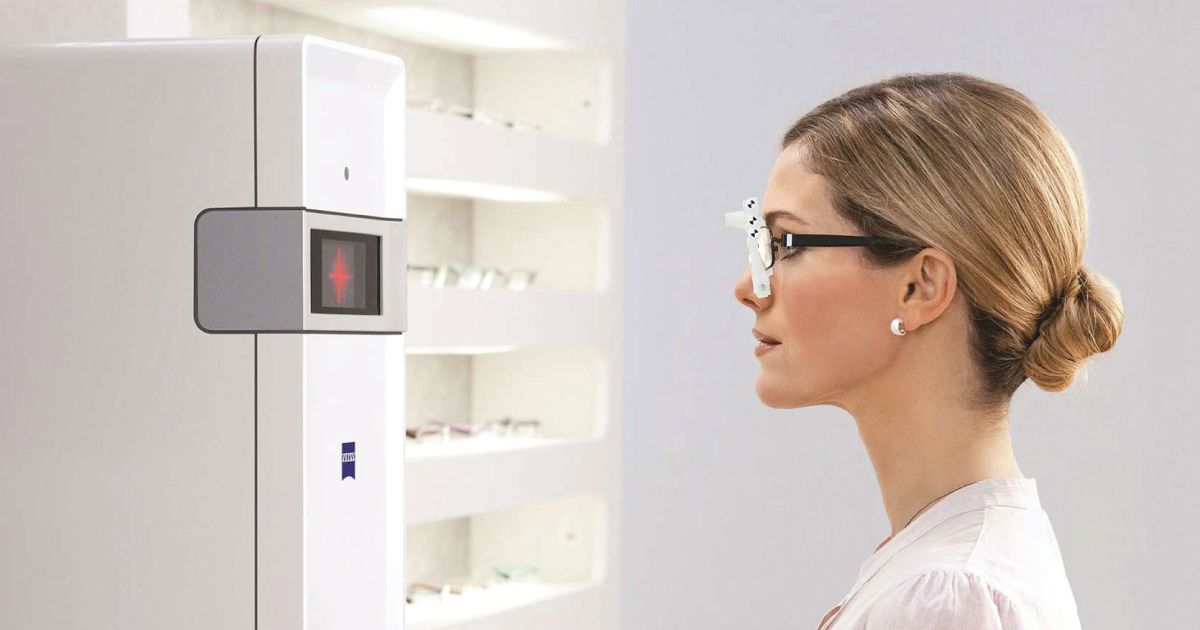
Today, advanced digital measuring technology allows opticians to capture far more than basic PD measurements. At Urban Optiks Optometry, we use the ZEISS i.Terminal 2 system to digitally measure:
- Pupillary distance
- Ocular height
- Vertex distance
- Pantoscopic tilt
- Frame wrap
- Posture and natural head position
These measurements are captured with a precision of 0.1 mm, creating a far more accurate and customized lens fitting experience than traditional manual methods.
This level of precision becomes especially important with progressive lenses, high-definition digital lenses, premium anti-fatigue designs, and high-index materials. Modern lenses are engineered with sophisticated optics that depend on highly accurate positioning in front of the eyes. Even small fitting inaccuracies can affect clarity, depth perception, peripheral vision, and overall comfort.
Rather than relying on estimations or generalized averages, digital measurement technology allows lenses to be customized specifically to how your frame sits on your face and how your eyes naturally align within the frame. The result is a more seamless, natural visual experience with sharper vision and improved adaptation.
Why Accurate Measurements Make a Difference
You use both eyes together all day, constantly shifting between near and far vision, screens and streets, indoor lighting and sunlight. If your lenses do not align properly with your natural focus point, your eyes must work harder to compensate.
Even slight measurement errors can lead to:
- Blurry vision or distorted edges
- Headaches and eye strain
- Dizziness or imbalance
- Difficulty transitioning between distances
Patients with stronger prescriptions or progressive lenses often notice these issues more quickly because those lens designs depend heavily on precise positioning.
When measurements are captured accurately using digital technology, your eyes can relax naturally. Vision feels sharper, transitions feel smoother, and everyday activities such as driving, reading, working on a computer, or walking outdoors become noticeably more comfortable.
The Problem with DIY Measurements
Many online retailers encourage customers to measure their own PD using a ruler, smartphone app, or credit card. While convenient, these methods rarely provide the same level of precision as professional digital measuring systems.
Common issues include:
- Difficulty holding measurements accurately while looking in a mirror
- Reusing outdated PD measurements from old eyewear
- Failing to account for frame position, tilt, or wrap
- Missing critical fitting data required for premium lens designs
Being off by only 1 or 2 millimeters may not sound significant, but in modern lens design, those differences matter. Glasses can look great cosmetically yet still feel uncomfortable or visually incorrect because the measurements behind them were inaccurate.
What Often Goes Wrong with Stylish Eyewear Online
Finding stylish eyewear online can be exciting, but without precise measurements behind the lenses, even beautiful frames may not perform properly.
Common issues include:
- Lenses that do not align with your natural eye position
- Distortion or blurry areas within the lens
- Frames that feel awkward or visually unbalanced
- Progressive or high-index lenses that become difficult to adapt to
Many online retailers never verify how your frame fits your face or how your lenses align once mounted. Measurements are often reduced to basic PD alone, ignoring the more advanced fitting data required for premium visual performance.
At Urban Optiks Optometry, we combine advanced digital measurement technology with personalized optical expertise to ensure your lenses are customized specifically for your eyes, prescription, frame choice, and natural posture. Our opticians work extensively with progressive, digital, and single-vision lens designs to maximize both clarity and comfort.
Takeaway
Exceptional eyewear is about more than style alone. Even the most beautifully designed frame can underperform if the lenses are not fitted accurately.
Modern digital measurement technology has transformed the way lenses are customized, allowing for far greater precision than traditional manual measuring methods ever could. By capturing detailed fitting information such as vertex distance, pantoscopic tilt, frame wrap, and posture with 0.1 mm accuracy, digital systems help ensure your lenses perform the way they were truly designed to.
The result is sharper vision, smoother adaptation, improved comfort, and a more natural visual experience throughout your day.
At Urban Optiks Optometry, we combine luxury independent eyewear with advanced digital measuring technology to create a truly customized visual experience. Whether you are selecting progressive lenses, premium digital lenses, or everyday eyewear, our team is dedicated to ensuring your glasses fit as precisely as they look stylish.
Explore our
curated eyewear collection or
schedule a personalized optical consultation today and experience the difference precise digital measurements can make.
Share this blog post on social or with a friend:
The information provided in this article is intended for general knowledge and educational purposes only and should not be construed as medical advice. It is strongly recommended to consult with an eye care professional for personalized recommendations and guidance regarding your individual needs and eye health concerns.
All of Urban Optiks Optometry's blog posts and articles contain information carefully curated from openly sourced materials available in the public domain. We strive to ensure the accuracy and relevance of the information provided. For a comprehensive understanding of our practices and to read our full disclosure statement, please click here.