Heterochromia: When Eye Color Tells a Story
Read time: 5 minutes
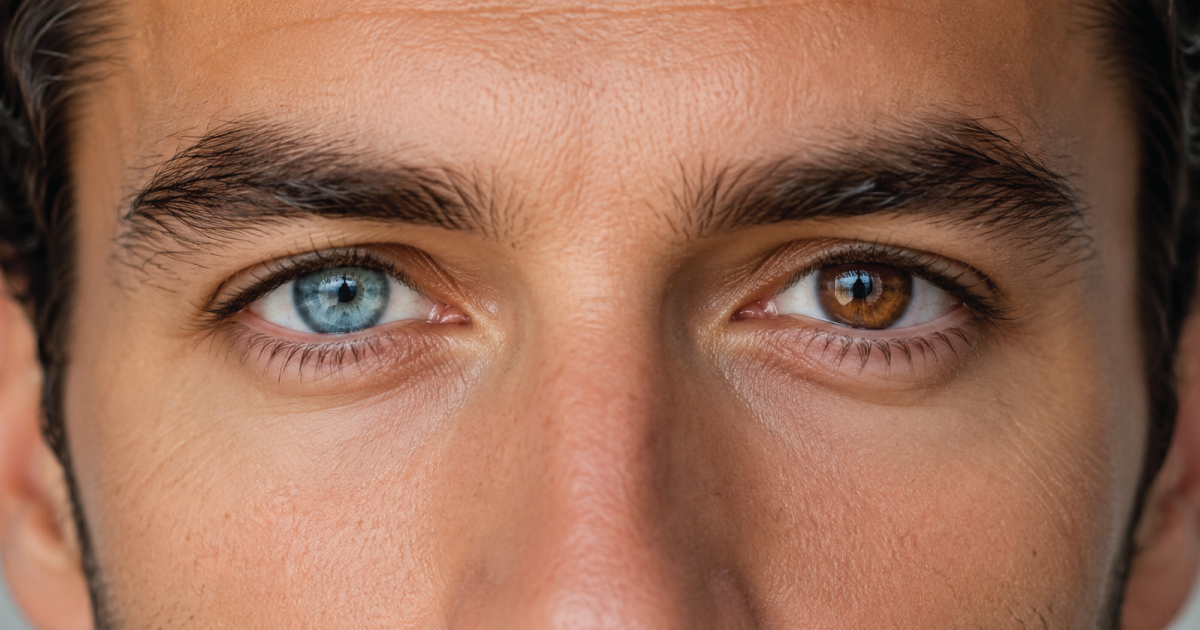
Most people have eyes that match in color, but some individuals have eyes that don’t look the same. This difference is called heterochromia, a condition where one eye differs in color from the other, or where part of one eye has a different color than the rest. While heterochromia often draws curiosity, it is usually harmless and simply part of how the eye develops.
Understanding what heterochromia is, how it forms, and what it can sometimes signal helps separate fascinating variation from situations that may need medical attention.
Heterochromia means different color. The word comes from Greek:
- heteros = different
- chroma = color
In eye care, heterochromia describes a difference in iris color, either:
- Between the two eyes, or
- Within a single eye
The term refers only to color variation.
What Is Heterochromia?
Heterochromia occurs when there is a difference in melanin, the pigment that gives color to the iris.
There are three main types:
- Complete Heterochromia - each eye is a completely different color, for example one blue eye and one brown eye
- Partial (Sectoral) Heterochromia - one eye contains two colors with a segment or wedge of the iris is a different shade
- Central Heterochromia - the center of the iris is a different color than the outer portion often seen as a ring around the pupil
All forms involve differences in how pigment is distributed within the iris.
Heterochromia in History
Long before modern eye care existed, people noticed heterochromia and often gave it symbolic meaning.
A look at the historical perspectives:
- In ancient cultures, mismatched eyes were sometimes linked to mysticism or spiritual significance
- Medieval Europe often viewed unusual eye color as a sign of uniqueness or rarity
- In some folklore, heterochromia was believed to represent dual identity or special perception
Without scientific understanding, these interpretations were shaped by observation rather than biology.
A Mark of Rarity and Identity
Throughout history, heterochromia has often been viewed as a symbol of rarity rather than a medical condition. In ancient societies, people with differently-colored eyes were sometimes believed to possess special insight or heightened perception.
In medieval Europe, mismatched eyes were occasionally linked to folklore and myth, simply because they were uncommon and poorly understood. Long before genetics explained pigment variation, heterochromia stood out as a visible reminder that human features do not always follow uniform patterns.
Today, science has replaced superstition, revealing that most cases are natural variations in iris pigmentation rather than signs of anything unusual or dangerous.
What Causes Heterochromia?
Heterochromia can be congenital (present at birth) or acquired later in life.
Congenital causes are typically harmless and occur during early development. They include:
- Genetic variation affecting melanin distribution
- Developmental differences in the iris
- Benign conditions present at birth
Acquired causes of heterochromia develops later in life, it may be related to changes inside the eye which may include:
- Eye injury or trauma
- Inflammation inside the eye (uveitis)
- Certain eye surgeries
- Pigment dispersion
- Tumors affecting the iris (rare)
- Some medications used to treat glaucoma
While most people born with heterochromia have no vision problems and require no treatment, sudden changes in eye color should always be evaluated by an eye care professional.
Does Heterochromia Affect Vision?
In most cases, heterochromia does not affect eyesight at all. Vision depends on the retina, optic nerve, and focusing system of the eye - not iris color.
However, if heterochromia is acquired due to an underlying condition, vision changes may occur depending on the cause.
Symptoms that should prompt an eye exam include:
- Eye pain
- Redness or inflammation
- Light sensitivity
- Blurred vision
- 4Sudden or noticeable color change
Heterochromia isn’t limited to medical textbooks, many well-known individuals have brought visibility to this unique eye trait.
Famous People With Heterochromia
Heterochromia is rare, but several well-known individuals have helped bring public awareness to the condition. Their visibility has helped normalize eye color differences and sparked curiosity about how and why they occur.
- Mila Kunis: Has partial heterochromia caused by inflammation in childhood, resulting in one green eye and one brown eye.
- Kate Bosworth:
Has sectoral heterochromia, with one eye appearing blue and the other blue with a brown segment.
- Alice Eve: Has complete heterochromia, with one blue eye and one green eye.
- Jane Seymour: Has heterochromia, with one eye green and the other brown.
These individuals demonstrate that heterochromia can be congenital or acquired, visible or subtle, and entirely compatible with normal vision and eye health.
Modern Understanding of Heterochromia
Today, eye doctors can examine heterochromia using advanced tools that allow close inspection of the iris and internal eye structures.
Modern eye exams may include:
- Slit-lamp examination
- Retinal imaging
- Eye pressure testing
- Detailed iris evaluation
These tools help determine whether heterochromia is a normal variation or linked to an eye condition.
The American Academy of Ophthalmology explains that evaluating heterochromia often involves close examination of the iris using tools, such as the slit lamp, that allow eye doctors to assess subtle structural and pigment differences.
Heterochromia vs. Central Color Variation
Many people mistake central heterochromia for simple eye color variation. In reality, subtle color rings or flecks are common and usually normal.
Key differences:
- Central heterochromia has a defined inner ring
- Normal variation blends more gradually
- Both are typically harmless
An eye exam can clarify the difference.
Can Eye Color Change Over Time?
Normal Changes:
- Babies often have lighter eyes that darken in early childhood
- Aging can slightly reduce melanin, causing subtle lightening
Concerning Changes:
- Sudden color changes in adulthood
- Uneven darkening or lightening
- Color change paired with discomfort or vision loss
While many eye color changes are harmless, certain shifts can signal changes inside the eye that should be evaluated promptly by an eye care professional.
The Takeaway
Heterochromia is a striking and often harmless variation in eye color that has fascinated people for centuries. In most cases, it reflects natural differences in pigment and has no impact on vision or eye health. However, when eye color changes occur suddenly or later in life, they can provide important clues about what’s happening inside the eye.
At Urban Optiks Optometry, careful examination and modern imaging allow us to distinguish between normal variation and conditions that need attention. Every eye tells a story. Understanding those details helps protect long-term vision.
Share this blog post on social or with a friend:
The information provided in this article is intended for general knowledge and educational purposes only and should not be construed as medical advice. It is strongly recommended to consult with an eye care professional for personalized recommendations and guidance regarding your individual needs and eye health concerns.
All of Urban Optiks Optometry's blog posts and articles contain information carefully curated from openly sourced materials available in the public domain. We strive to ensure the accuracy and relevance of the information provided. For a comprehensive understanding of our practices and to read our full disclosure statement, please click here.